BRC Mesh and Deformed Steel Bars Supplier in UAE | Moazzam Ali Building Material Trading LLC

BRC Mesh and Deformed Steel Bars Supplier in UAE
BRC Mesh and Deformed Steel Bars Every strong building starts below the surface — in the steel that holds the concrete together. Whether it’s a villa in Sharjah, a warehouse in Jebel Ali, or a high-rise in Downtown Dubai, the reinforcement you choose determines how long that structure lasts and how safely it performs under load. Two materials sit at the heart of almost every concrete pour in the UAE: BRC mesh and deformed steel bars.
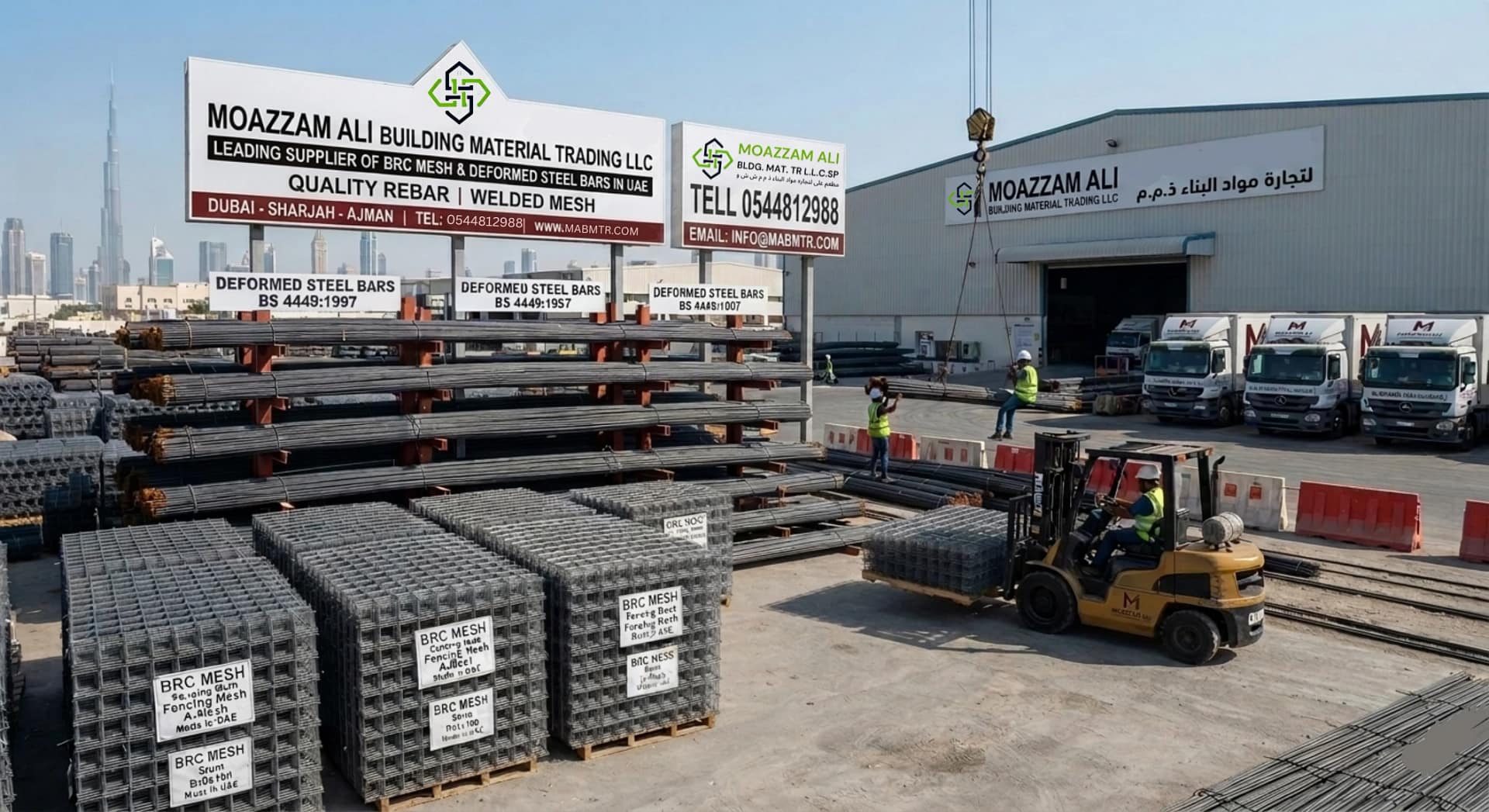
At Moazzam Ali Building Material Trading LLC, we supply both — consistently, in bulk, and on schedule — to contractors, engineers, developers, and precast manufacturers across the UAE. This guide breaks down what these materials are, where they’re used, and how to decide which one (or combination) fits your next project.
What Is BRC Mesh?
BRC mesh — short for British Reinforcement Concrete mesh, and also called welded wire mesh or welded wire fabric — is a grid of steel wires fused together at every intersection using electric resistance welding. The result is a rigid, evenly spaced sheet or roll of reinforcement that can be laid into position far faster than tying individual bars by hand.
Because it’s manufactured to fixed grid patterns and wire diameters, BRC mesh delivers a level of consistency that’s hard to replicate on-site with manual tying. Every sheet leaving the factory carries the same spacing, the same strength, and the same load-bearing behaviour — which matters a great deal when a consulting engineer is signing off on structural drawings.
Where BRC Mesh Gets Used
- Concrete floor slabs in warehouses and factories
- Residential and villa foundations
- Commercial building floors and podiums
- Parking structures and multi-storey car parks
- Roads, pavements, and hardstanding areas
- Footpaths and sidewalks
- Boundary and compound walls
- Precast concrete panels, pipes, and blocks
- Water tanks and reservoirs
- Infrastructure and utility projects
Why Contractors BRC Mesh and Deformed Steel Bars Prefer It
Speed on site. Because the mesh arrives pre-fabricated, crews roll or lay it into place instead of tying hundreds of individual intersections — cutting reinforcement time dramatically on large slabs.
Even load distribution. The uniform wire spacing spreads structural loads evenly across the concrete, reducing stress concentration points.
Crack control. Shrinkage cracking and temperature-related surface cracks are one of the most common complaints on large concrete pours. A properly specified mesh layer significantly reduces both.
Lower labour cost. Fewer man-hours tying steel translates directly into lower site labour bills — a real saving on large-footprint projects.
Factory-grade consistency. No guessing on spacing or wire diameter — what’s ordered is what arrives.
Overall cost efficiency. Faster installation plus reduced wastage usually makes mesh the more economical choice for flat, large-area reinforcement work.
What Are Deformed Steel Bars?
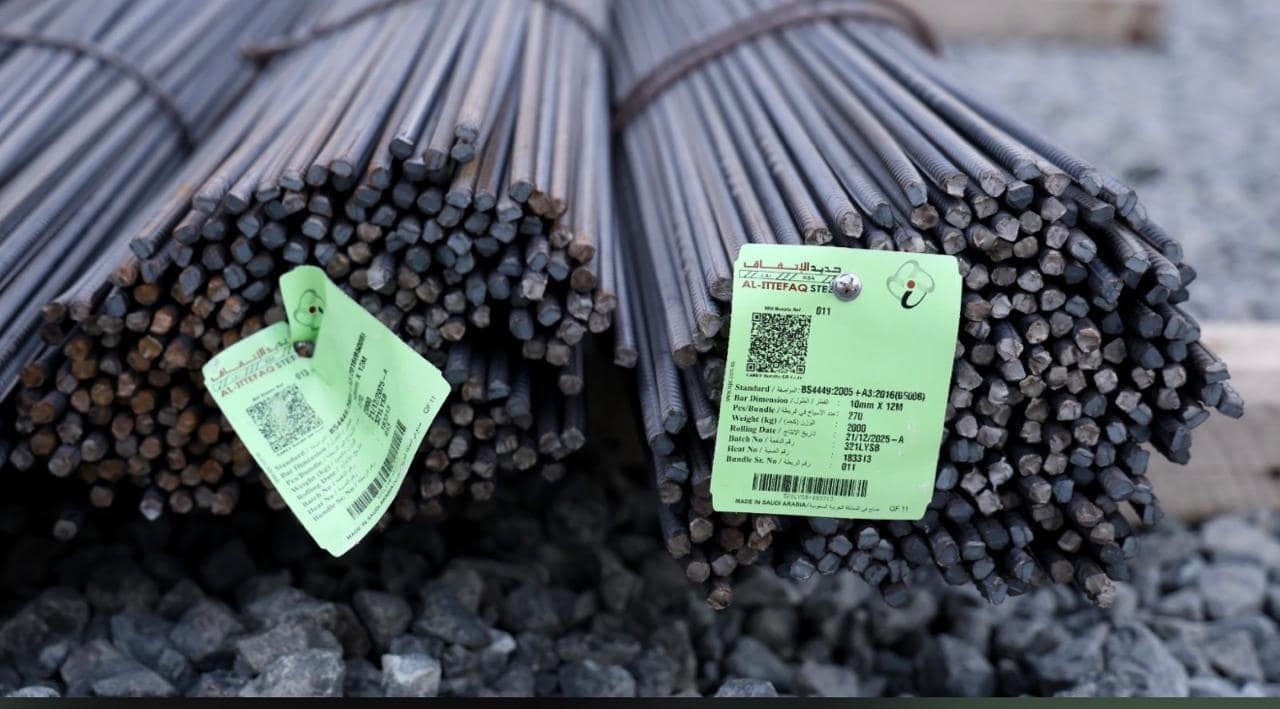
Deformed steel bars, widely known simply as rebar, are the ribbed steel rods that give reinforced concrete its ability to resist tension. Unlike plain round bars, deformed bars have raised patterns rolled into the surface. Those ribs lock mechanically into the surrounding concrete, so the two materials move and bear load together instead of slipping apart under stress.
This bond is what allows reinforced concrete to do something concrete alone cannot: resist bending, tension, and seismic movement, not just compression.
Where Deformed Bars Get Used
- Foundations and footings
- Structural columns
- Beams and slabs
- High-rise and multi-storey buildings
- Villas and low-rise residential buildings
- Commercial towers and mixed-use developments
- Industrial warehouses and factory frames
- Bridges and flyovers
- Retaining walls
- Dams and marine structures
- Roads and infrastructure works
Why Deformed Bars Are Non-Negotiable in Structural Work
Mechanical bonding. The ribbed profile grips the concrete far more effectively than a smooth bar, so the structure resists slipping and cracking under load.
High tensile capacity. Deformed bars carry the tension loads that concrete alone can’t handle, particularly in beams, columns, and suspended slabs.
Long-term durability. Correctly specified and properly coated bars resist corrosion and hold their strength over decades of service.
Structural safety. In a region where wind loads, thermal movement, and occasional seismic activity are real design considerations, rebar strength is what keeps a structure standing.
Wide grade and size range. Available in multiple diameters and strength grades, so engineers can specify exactly what a given structural element requires — nothing over-engineered, nothing under-designed.
BRC Mesh vs. Deformed Steel Bars: Quick Comparison: BRC Mesh and Deformed Steel Bars
| Feature | BRC Mesh | Deformed Steel Bars |
|---|---|---|
| Form | Pre-welded steel mesh sheets/rolls | Individual ribbed steel bars |
| Installation | Fast — laid into position | Manual placement and tying |
| Best suited for | Slabs, pavements, walls, precast panels | Foundations, columns, beams, high-rise frames |
| Labour requirement | Low | Moderate to high |
| Installation speed | Faster | Standard |
| Primary role | Crack and shrinkage control, surface reinforcement | Tensile strength, load-bearing structural support |
In practice, these two materials aren’t competitors — they’re teammates. Most mid-to-large scale UAE projects use deformed bars for the structural frame (columns, beams, foundations) and BRC mesh for slabs, pavements, and secondary reinforcement, giving the project both structural strength and surface durability.
Choosing the Right Reinforcement for Your Project BRC Mesh and Deformed Steel Bars
A few questions worth asking before placing an order BRC Mesh and Deformed Steel Bars:
- Is this a structural element (column, beam, foundation) or a surface element (slab, pavement, wall)? Structural elements almost always need deformed bars; surface elements often do well with mesh, sometimes both.
- What load and span are involved? Larger spans and heavier loads typically call for higher-grade deformed bars sized by a structural engineer.
- How tight is the construction schedule? If speed of installation matters, mesh reduces labour time significantly on flat, large-area pours.
- What do the approved structural drawings specify? Always work from engineer-approved specifications — the right material is the one your project’s design calls for, not just the cheaper or faster option.
Why Work BRC Mesh and Deformed Steel Bars Moazzam Ali Building Material Trading LLC
Sourcing reinforcement steel isn’t just about price — it’s about getting the right specification, on time, every time, without holding up your pour schedule. That’s what we focus on:
- Consistent stock availability of BRC mesh and deformed bars across standard sizes and grades
- Reliable, on-time delivery to job sites across the UAE
- Quality-checked material that meets the specifications contractors and consultants require
- Support for projects of every scale — from a single villa to large industrial and infrastructure developments
- Straightforward, responsive service for contractors, engineers, and procurement teams
If your project needs dependable reinforcement supply — whether it’s mesh, rebar, or both — get in touch with Moazzam Ali Building Material Trading LLC to discuss your requirements and delivery timeline.
FAQ: BRC Mesh and Deformed Steel Bars
1. What is the difference between BRC Mesh and Deformed Steel Bars?
BRC mesh is a pre-welded grid of steel wires used mainly for surface reinforcement — slabs, pavements, and walls. Deformed steel bars are individual ribbed rods used for structural elements like columns, beams, and foundations, where high tensile strength is required. Most projects use both together.
2. Can BRC mesh be used instead of rebar in a foundation?
No. Mesh is designed for shrinkage and crack control in flat surface areas, not for carrying heavy structural loads. Foundations, columns, and beams require deformed bars sized by a structural engineer, since they must resist tension and bending forces mesh isn’t built for.
3. What sizes and grades of deformed steel bars are available?
Deformed bars typically come in a range of diameters (commonly from 8mm up to 32mm or more) and strength grades. The right size and grade depend on the load, span, and design specified in the approved structural drawings — always follow the engineer’s specification rather than guessing.
4. Is BRC mesh sold in sheets or rolls?
Both. Sheets are common for larger flat areas like warehouse floors and slabs, since they’re quick to lay and align. Rolls are often used for smaller or irregular areas, boundary walls, and applications where cutting to custom lengths is easier.
5. Does BRC Mesh and Deformed Steel Bars construction time?
Yes, significantly. Because it arrives pre-fabricated, crews lay it into place instead of tying every intersection by hand, which speeds up reinforcement work on large slabs and cuts labour hours.
6. Why do deformed bars have ribs instead of a smooth surface?
The ribbed surface creates mechanical interlock with the surrounding concrete. This bond stops the bar from slipping inside the concrete under load, which is essential for the reinforced section to behave as one strong composite unit rather than two separate materials.