
Roofing, Cladding & Flashing Accessories in UAE: Complete Solutions for Modern Buildings

Walk onto almost any Cladding Flashing Accessories in UAE construction site in the UAE and you’ll notice the big stuff first — the roofing sheets, the wall panels, the structural frame going up. What you won’t notice, unless you know to look for it, are the smaller components tucked into every joint, corner, and edge. Those pieces are flashing, gutters, and trim, and they quietly determine whether a roof survives ten years or twenty-five.
In a climate as demanding as the UAE’s — scorching sun for most of the year, sudden intense rainfall, blowing sand, and daily temperature swings that stress every seam — these accessories aren’t a finishing touch. They’re the actual line of defense against water intrusion, corrosion, and structural wear. Get them wrong, and even the best roofing sheets in the world won’t save a building from leaks.
The Roof Is a System, Flashing Accessories Not a Surface
It’s easy to think of a roof as one continuous piece of material, but in reality it’s dozens of components working together. The main sheets cover the bulk of the area, but every ridge, valley, edge, and wall junction is a separate point where water can potentially get in. Flashing exists specifically to close those gaps.
This is why so many roofing failures don’t start with the main roofing material at all — they start at a poorly sealed corner, an undersized gutter, or flashing that wasn’t shaped to match the roof profile properly. In the UAE, where coastal humidity and inland dust create two very different sets of stress on materials, these weak points show up fast if the accessories aren’t right.
Breaking Down the Flashing Accessories Key Accessories
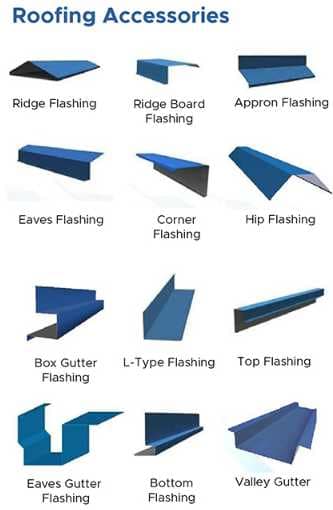
Ridge Flashing and Ridge Board Flashing
At the very top of a sloped roof, where two roof planes meet, ridge flashing caps the junction and stops wind-driven rain from pushing underneath the sheets. Ridge board flashing does a similar job but suits slightly different roof structures, giving installers options depending on the design.
Apron Flashing
Wherever a roof meets a wall or another vertical surface, apron flashing steps in to redirect water away from that seam instead of letting it collect and eventually seep through.
Eaves Flashing
Along the lowest edge of the roof, water naturally gathers before it drains off. Eaves flashing protects this high-traffic zone, which matters a lot during the UAE’s short but intense rain events.
Corner Flashing and Hip Flashing
Angled roof sections are some of the hardest areas to seal well. These flashings are custom-shaped to follow those angles precisely, closing off the gaps that straight flashing simply can’t cover.
Box Gutter Flashing, L-Type Flashing, and Top Flashing
Different roof designs call for different drainage approaches. Box gutter flashing pairs with recessed gutter systems built into the roof, L-type flashing gives a simpler angled seal for basic transitions, and top flashing caps exposed edges against water and debris.
Eaves Gutter Flashing, Bottom Flashing, and Valley Gutter
These pieces manage water at the lower edges and in the valleys where two roof slopes converge. Valley gutters especially carry a heavy volume of water during storms, so their build quality has a direct impact on how the whole roof performs under pressure.
Cladding Accessories: Flashing Accessories Protecting the Vertical Surfaces
Flashing Accessories look after everything above, but cladding accessories take care of the building’s vertical faces — facades, wall panels, and exterior finishes. In the UAE, cladding has to manage two jobs at once: looking sharp architecturally while resisting UV degradation, heat expansion, and sand abrasion. The trims and flashing used with cladding function the same way roofing flashing does, sealing joints so water and air can’t work their way behind the panels over time.
Why Material Choice Matters So Much Here
Flashing Accessories or gutter product is built to handle UAE conditions. Galvanized steel, aluminum, and coated metal sheets tend to outperform basic materials because they resist corrosion far better, which matters given the combination of heat, coastal humidity, and airborne dust the country deals with.
Fabrication quality counts just as much as the raw material. Accurate bends and consistent thickness determine how snugly flashing fits against the roofing sheets it’s protecting. Even premium material won’t help much if the piece doesn’t sit flush — gaps defeat the purpose regardless of what it’s made from.
The Case for Sourcing Everything Together
A pattern that shows up again and again on real projects: mixing accessories from multiple suppliers usually creates small but frustrating mismatches — slightly different profiles, colors, or coatings that don’t align cleanly. Sourcing roofing, cladding, and flashing accessories from one supplier who designs them to work as a set tends to cut down on installation problems and speeds up the build.
Flashing Accessories project is a warehouse that needs robust eaves and valley protection, a villa with detailed ridge and apron work, or a commercial building relying on cladding trims for its exterior, having a complete range to pull from makes it far easier to get the right fit the first time.
Final Thoughts
Flashing Accessories gutters, and trim rarely get any credit, but they’re doing the heavy lifting behind the scenes. In the UAE’s tough climate, investing in quality accessories — and making sure they’re fitted correctly — is one of the simplest ways to protect a building’s lifespan. It’s unglamorous work, but it’s the kind that keeps paying off long after the project is finished.
