Best Sandwich Panel in Dubai, Ajman & Sharjah: The Complete Buyer’s Guide for UAE Projects
Why Dubai, Ajman, and Sharjah Are the UAE’s Biggest Markets for Sandwich Panels
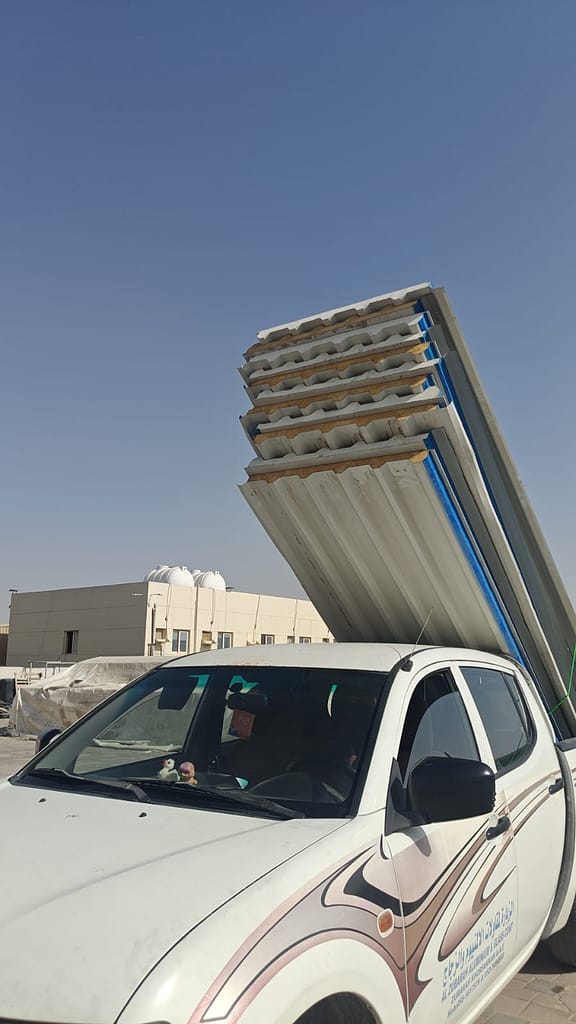
Construction in the Northern Emirates and Greater Dubai is moving fast. Warehouses are going up in Al Quoz, Sajaa, and Umm Al Quwain Road. Industrial zones in Ajman Free Zone and Hamriyah Free Zone are expanding. Cold storage demand in Sharjah is growing alongside the logistics boom. And everywhere you look, contractors and project managers are specifying sandwich panels.
The reason is straightforward. Each emirate has its own construction pressure points — and sandwich panels address all of them at once: they go up quickly, perform well in extreme heat, and cost significantly less over a building’s lifetime than traditional brick-and-block construction.
At MABMTR (Moazzam Ali Building Material Trading), we supply sandwich panels to projects across Dubai, Ajman, Sharjah, and the wider UAE. This guide is for contractors, warehouse owners, developers, and anyone else who needs to understand what they are actually buying before they commit.
What Makes Sandwich Panels the Right Choice for UAE Construction
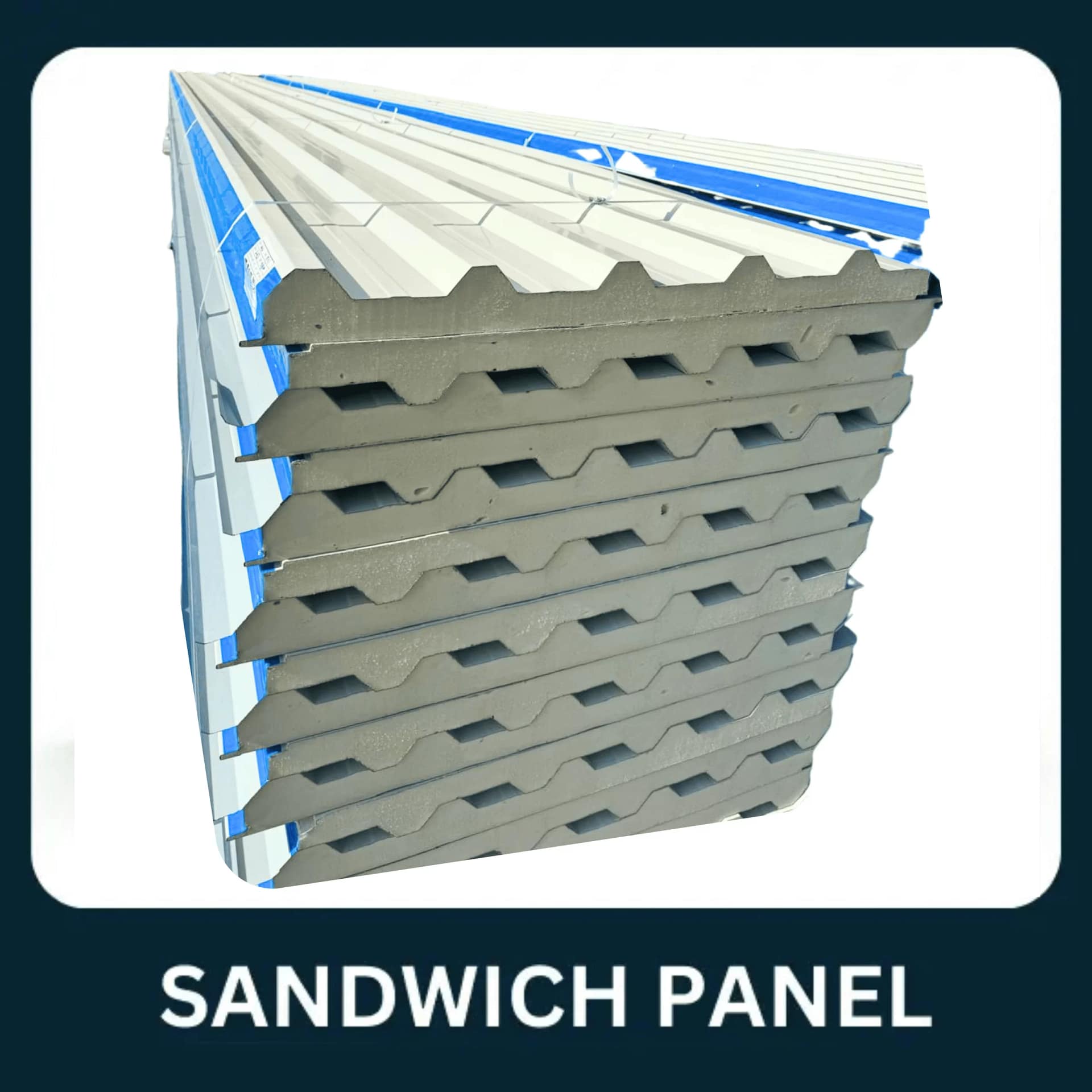
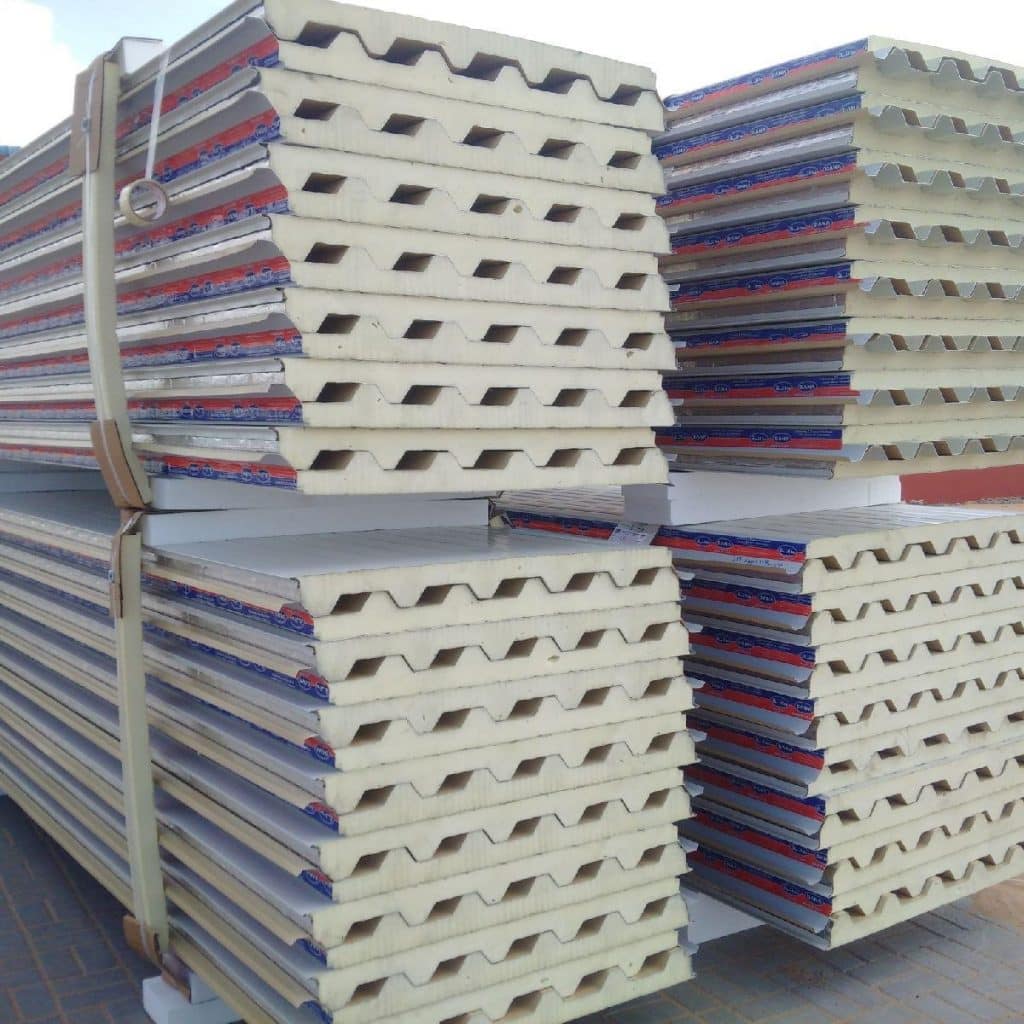
A sandwich panel is three layers working as one. Two outer steel sheets — pre-coated, galvanised, and finished — wrap around an insulating core. That core is where the real performance comes from. Depending on the core material, you get different levels of thermal insulation, fire resistance, and acoustic control.
In the UAE, where summer temperatures inside an uninsulated steel warehouse can hit 60°C or more, the core material is not a technical detail — it is the reason your workers can function, your machinery doesn’t overheat, and your air conditioning system doesn’t run at full capacity around the clock.
The result is a building material that outperforms alternatives in almost every relevant category for UAE conditions: installation speed, insulation performance, structural efficiency, and long-term running costs.
Sandwich Panel Types Available from MABMTR
PU (Polyurethane) Sandwich Panels — Best Thermal Performance
PU panels are the most widely used sandwich panel in the UAE market, and for good reason. Polyurethane foam has one of the lowest thermal conductivity ratings of any insulation material available at scale. This means thinner panels can achieve the same insulation performance as much thicker alternatives — a genuine advantage when internal dimensions matter.
In Dubai’s industrial zones — Al Quoz, JAFZA, DIP — where warehouse rents are calculated per square foot of internal space, a wall system that delivers the same insulation with 20% less wall thickness has real commercial value.
PU panels from MABMTR are available in thicknesses from 50mm to 150mm, in multiple profile options for both roof and wall applications, and in a range of RAL colours to meet project or municipality requirements.
Ideal for: Warehouses, factories, commercial buildings, modular structures, fast-track projects.
PIR (Polyisocyanurate) Sandwich Panels — Enhanced Fire Rating
PIR panels look similar to PU panels and offer comparable thermal performance, but the chemistry of the core material is different. PIR foam is inherently more fire-resistant than standard PU. In fire tests, PIR panels hold their structural integrity longer and produce lower levels of toxic smoke — a meaningful distinction for occupied buildings and facilities storing flammable goods.
For projects in Sharjah and Ajman that require civil defence approval, PIR panels often simplify the sign-off process by meeting fire rating requirements without additional treatment or cladding. If your project involves storage of goods that carry fire risk — chemicals, packaging, textiles — PIR is worth specifying from the outset.
Ideal for: Facilities with fire safety compliance requirements, storage of flammable materials, occupied commercial buildings.
Rock Wool (Mineral Wool) Sandwich Panels — Fire Resistance and Sound Control
Rock wool core panels offer the highest fire resistance of any sandwich panel type in common use across the UAE. The mineral wool core is non-combustible — it does not burn, does not melt, and does not contribute fuel to a fire. For buildings where civil defence regulations mandate a specific fire rating, or where insurance requirements specify non-combustible materials, rock wool panels are the correct specification.
Beyond fire performance, rock wool also provides meaningful sound insulation. In industrial areas of Ajman and Sharjah where multiple facilities operate in close proximity, acoustic separation between units is a genuine operational concern. A production facility next to a food packing operation, or a workshop adjacent to an office building, benefits from the sound-dampening properties that rock wool delivers more effectively than foam-core alternatives.
Ideal for: High fire-risk environments, buildings requiring civil defence fire rating, facilities where acoustic separation matters.
Sandwich Panels in Dubai — What to Know Before You Order
Dubai’s construction environment is one of the most regulated in the region. Civil defence requirements for industrial buildings, JAFZA and DIP authority standards, and municipality approvals all affect what can be specified and installed.
The most important compliance questions for sandwich panels in Dubai projects are:
Fire rating. Civil defence in Dubai requires buildings above certain sizes and occupancies to meet specific fire classification standards. The panel core material, thickness, and cladding finish all contribute to the fire performance rating. A reputable supplier will provide test certificates and compliance documentation upfront — not after the panels have arrived on site.
Panel thickness and U-value. Dubai Municipality increasingly expects buildings to meet energy efficiency standards. The thermal performance of your wall and roof panels contributes directly to your building’s overall energy compliance. MABMTR can advise on the correct panel specification to meet current requirements.
Colour and finish. Many industrial zones in Dubai have specific requirements or preferences for external cladding colours. MABMTR supplies panels in a range of standard RAL colours, and non-standard finishes are available for projects with specific requirements.
Sandwich Panels in Ajman — Industrial Zone Applications
Ajman Free Zone and the surrounding industrial areas in Ajman are home to a dense concentration of light manufacturing, trading, and storage operations. Most of the industrial units in this area are either pre-engineered steel structures or concrete-framed buildings with infill panels — both of which are natural applications for sandwich panels.
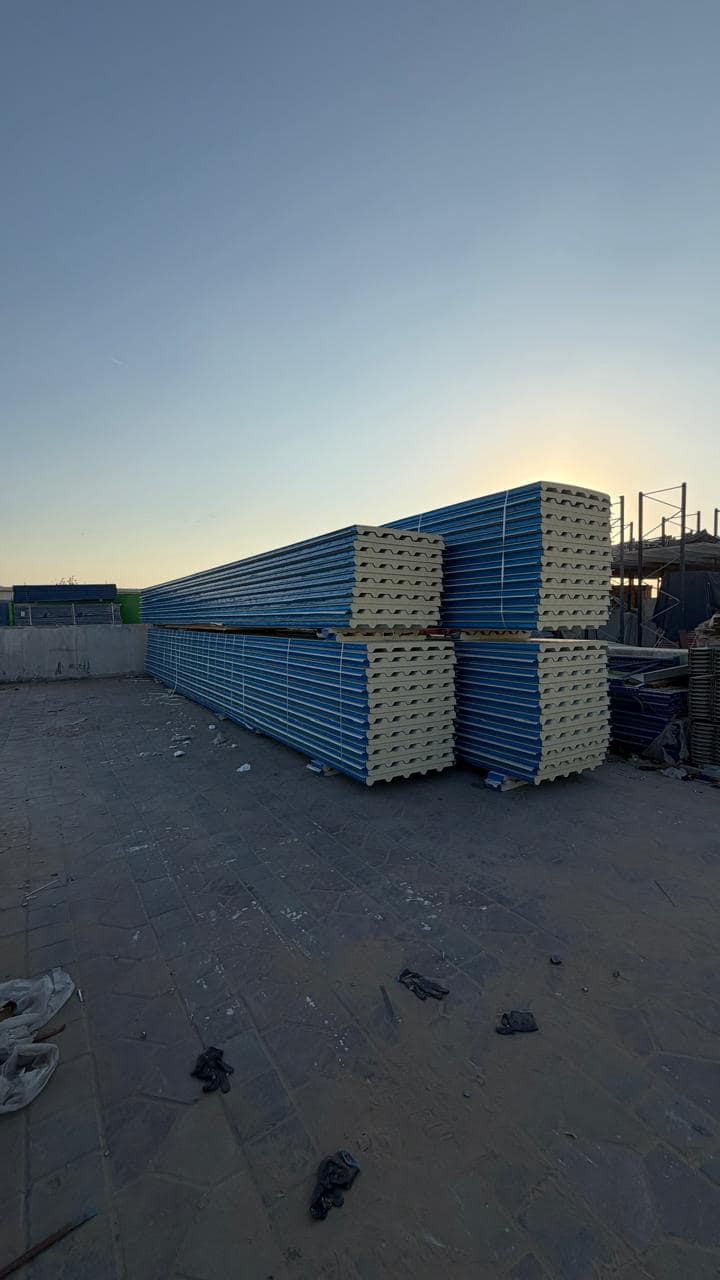
For steel frame structures, sandwich panels are typically used for the full envelope: roof panels spanning the purlins, wall panels cladding the girts. The speed advantage here is significant. A large warehouse envelope can be installed in days rather than the weeks required by block laying and plastering.
For concrete-framed buildings, sandwich panels are increasingly used as infill wall panels — replacing traditional blockwork with a lighter, faster, better-insulated alternative. The reduced wall weight also lowers loads on floor slabs and foundations, which has structural and cost implications at the design stage.
MABMTR supplies to Ajman projects with fast turnaround from our UAE stock. For standard panel sizes and thicknesses, delivery to Ajman can typically be arranged within 48–72 hours of order confirmation.
Sandwich Panels in Sharjah — Cold Chain and Logistics Demand
Sharjah has become one of the UAE’s most important logistics corridors, connecting Dubai’s port and airport infrastructure with the east coast via the Dhaid Road corridor, and serving the Northern Emirates from industrial zones in Sajaa, Hamriyah, and Saja’a Industrial Area.
Cold storage demand in Sharjah is particularly strong. The emirate’s growing food distribution sector, combined with pharmaceutical logistics operations expanding out of more expensive Dubai locations, has driven significant demand for insulated panel systems that can maintain controlled temperatures under Gulf summer conditions.
MABMTR supplies dedicated cold room panels — higher-density PU or PIR cores with specific vapour barriers and jointing systems — as well as standard insulated roof and wall panels for ambient warehousing. Our experience with cold chain projects across Sharjah means we understand the specification requirements: panel thermal resistance, floor-to-ceiling continuity, condensation management, and the load ratings needed for refrigeration equipment mounting.
For logistics facilities in Sharjah requiring a combination of cold storage and ambient warehousing in the same building, we can supply panels to meet both specifications from a single order.
Roof Panels vs Wall Panels — Understanding the Difference
These terms are sometimes used interchangeably but they refer to products with different profiles and structural characteristics.
Roof sandwich panels are designed to span between purlins across a sloped or low-pitch roof. The outer profile is usually a deeper rib or trough shape that helps channel rainwater to gutters, withstand wind uplift, and carry the panel’s own weight plus any imposed loads. Thicknesses of 75mm to 100mm are common for UAE industrial roofs, where insulation has the most impact on internal temperatures.
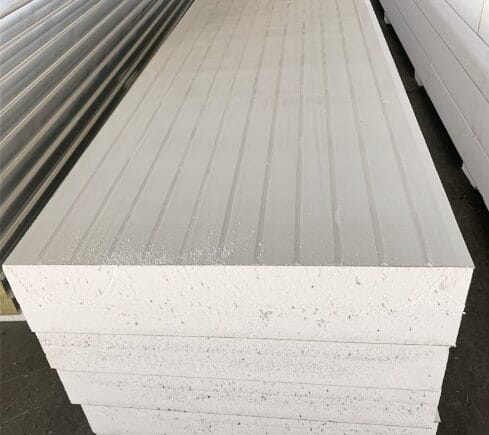
Wall sandwich panels typically have a flatter or shallower outer profile. They need to resist wind pressure and impact loads rather than spanning large distances under gravity. For walls, panel thickness is selected based on insulation requirements and local thermal regulations rather than structural span.
MABMTR supplies both types. If your project requires both roof and wall panels, combining them in a single order from us reduces delivery costs and ensures profile compatibility at eaves, corners, and junctions.
How to Order Sandwich Panels from MABMTR
Ordering sandwich panels is not as simple as specifying a standard product from a catalogue. The right order depends on your structure type, span between purlins or girts, load requirements, insulation specification, civil defence requirements, and project timeline.
Our process:
Step 1 — Tell us about your project. Building type, location (Dubai / Ajman / Sharjah / other), floor area, whether you need roof panels, wall panels, or both, and your required delivery date.
Step 2 — We advise on specification. Our team will recommend the correct panel type (PU / PIR / rock wool), thickness, and profile for your application — with documentation available for civil defence submissions where required.
Step 3 — We confirm pricing and delivery. We provide a clear quote with panel cost, cutting list if required, and delivery schedule to your site anywhere in the UAE.
Step 4 — Installation support. Our sister company SASTS (Sama Al Shahba Technical Services) handles professional installation. If you need supply only, we deliver. If you need supply and fit, we coordinate both under one contract.
Get a Fast Quote — Dubai, Ajman, Sharjah, and All UAE
Whether you are pricing a new warehouse in Ajman Free Zone, replacing a damaged roof in Al Quoz, or specifying panels for a cold store in Sajaa, MABMTR can supply the right product quickly and at a competitive price.
We hold stock in the UAE and can move fast when your project needs us to.
📞 Call: 0544812988
🌐 Website: mabmtr.com
📍 Serving: Dubai | Ajman | Sharjah | Abu Dhabi | RAK | Fujairah | All UAE
Frequently Asked Questions — Sandwich Panels in the UAE
Q: What is the most popular sandwich panel thickness for warehouses in Dubai?
For roof panels, 75mm to 100mm PU or PIR is the most common specification. For walls, 50mm to 75mm is typical for ambient warehousing in the UAE.
Q: Do sandwich panels require civil defence approval in Ajman and Sharjah?
Yes. Most commercial and industrial buildings in Ajman and Sharjah require civil defence approval, and panel fire ratings must be documented. PIR and rock wool panels are generally easier to clear in fire safety submissions.
Q: How long does delivery take for sandwich panels in Sharjah?
For standard stock sizes, MABMTR can typically deliver to Sharjah within 48–72 hours. Custom lengths and profiles may require additional lead time.
Q: Can sandwich panels be used for both walls and roofs in the same project?
Yes. MABMTR supplies both roof and wall panel profiles. We advise on panel selection for each part of the building envelope and can supply both from a single order.
Q: What is the difference between PU and PIR sandwich panels?
Both offer excellent thermal insulation. PIR has a higher fire resistance rating and is preferred for projects with strict civil defence or insurance fire requirements. PU is typically slightly more cost-effective for standard ambient warehousing.