
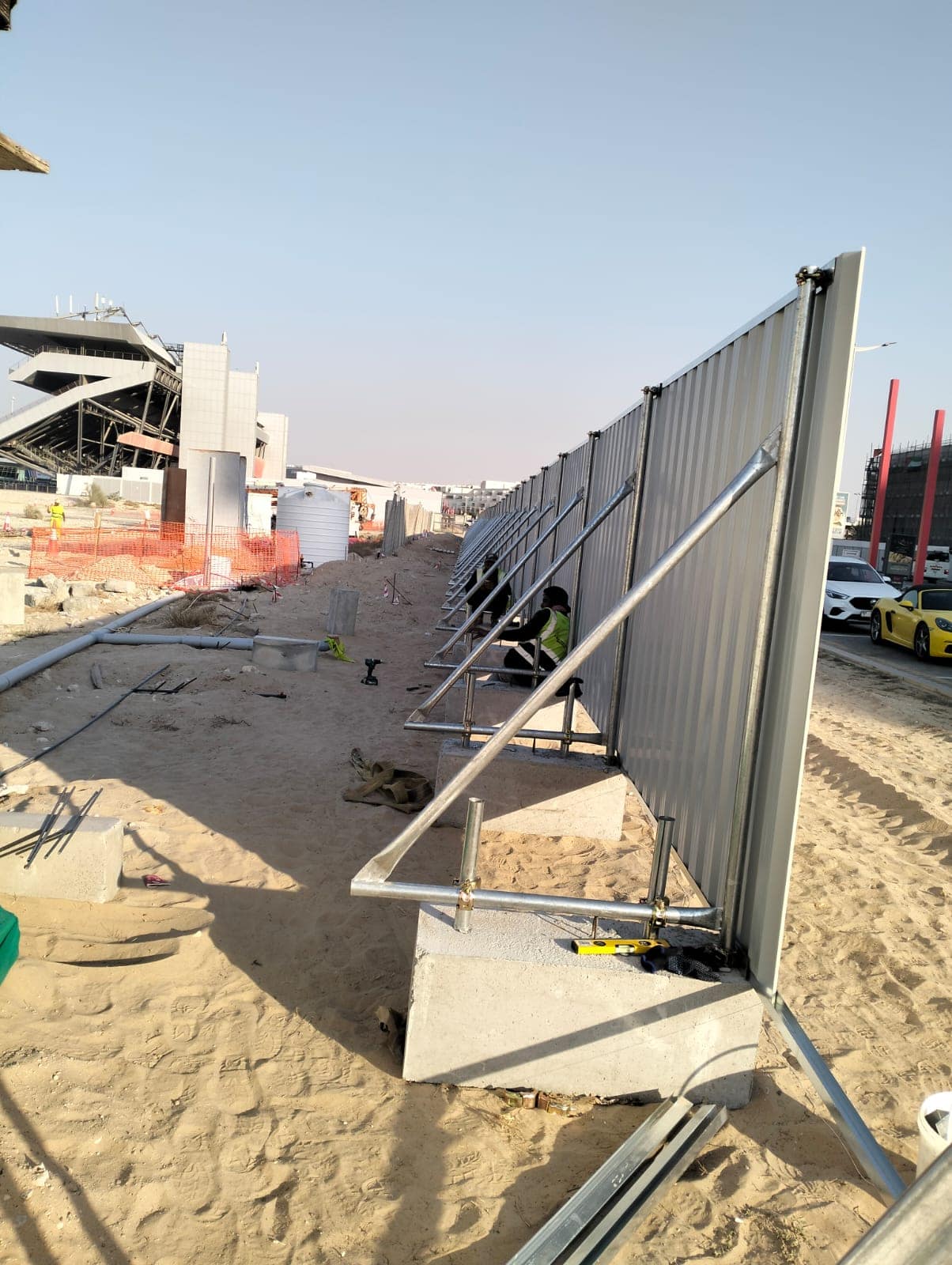
Temporary Fencing in the UAE: A Practical Guide to Choosing the Right Type for Your Site

Anyone who has managed a Temporary Fencing in the UAE knows that fencing is rarely the exciting part of the job — until something goes wrong. A gap in the perimeter, a curious passerby wandering onto site, or a strong gust of wind knocking over a poorly secured panel can turn into a safety incident, a delay, or a costly liability claim.
That’s why temporary fencing deserves more attention than it usually gets. With Dubai, Abu Dhabi, Sharjah, and the wider Emirates in a near-constant state of construction — new towers, roads, utility upgrades, and public events — the demand for dependable temporary fencing has never been higher.
This guide walks through the main types of temporary fencing used across UAE job sites, what each one is actually good for, and how to think through the decision so you’re not paying for security you don’t need — or worse, skimping on protection you do.
Why Temporary Fencing in the UAE Matters More Than It Seems
A fence isn’t just a visual boundary. On an active site, it’s doing several jobs at once:
- Keeping unauthorized people out of a hazardous area
- Protecting materials, tools, and equipment from theft
- Signaling to the public where it’s safe to walk
- Helping contractors meet municipality and safety-authority requirements
- Reducing noise and dust spillover into neighboring areas
Get the fencing wrong, and you’re exposed on more than one of these fronts at once.
The Main Types of Temporary Fencing in the UAE Used
Here’s a rundown of the Temporary Fencing in the UAE you’ll most commonly come across on UAE sites, along with where each one genuinely earns its place.
1. Chain Link Fencing
This is the fencing most people picture when they think “construction site.” Galvanized steel mesh stretched across a metal frame, it’s been the industry default for decades — and for good reason.
What it’s good at: It’s inexpensive, quick to put up, and lets security staff see straight through it, which makes monitoring easier. It also holds up reasonably well against UAE heat and dust once installed correctly.
Where it falls short: Anyone walking past can see exactly what’s happening on site. If privacy or a polished public image matters, this isn’t your fence.
Typical use: Warehouses, storage yards, general construction boundaries, short-duration projects.
2. Welded Mesh Fencing
Think of this as chain link’s sturdier cousin. Instead of woven wire, the mesh is welded at every intersection, which makes the whole panel much harder to cut, bend, or pry apart.
What it’s good at: Better resistance to tampering, smaller mesh gaps that discourage climbing, and a cleaner, more professional look than basic chain link.
Where it falls short: Costs more than chain link, and still offers no privacy.
Typical use: Infrastructure builds, utility corridors, longer-term projects where the fencing needs to survive months of exposure without degrading.
3. Heras-Style Mobile Fencing
Named after the brand that popularized it, this modular panel-and-clamp system has become so common that a lot of people in the industry use “Heras fencing” as a catch-all term, the way people say “Kleenex” for tissues.
What it’s good at: Speed. Panels click together, sit on weighted feet, and can be reconfigured as the site layout changes — handy on projects where the footprint shifts week to week.
Where it falls short: It’s mobile by design, which means it’s not the fence you’d choose for a site holding high-value assets.
Typical use: Civil works, demolition sites, event perimeters, anywhere the boundary needs to flex.
4. Anti-Climb Fencing
When the stakes are higher — expensive machinery on site, sensitive infrastructure, restricted zones — this is the upgrade worth paying for. The mesh openings are deliberately too small to get a foothold or handhold on.
What it’s good at: Genuinely deterring intrusion, not just discouraging it. It pairs well with cameras and access control for sites that need layered security.
Where it falls short: Higher cost, and it’s overkill for low-risk sites.
Typical use: Power infrastructure, airports, government-adjacent sites, any project where a security breach would be expensive or dangerous.
5. Hoarding Panels
Solid, opaque panels that block the site from view entirely — this is what you see wrapping city-center developments in Dubai and Abu Dhabi, often branded with the project name or developer logo.
What it’s good at: Full privacy, a tidier public-facing appearance, and decent wind resistance when properly braced. Many developers also use the panels as free advertising space.
Where it falls short: More expensive than mesh-based options, and installation takes longer.
Typical use: Urban construction, mall and residential developments, any site where the street-level look matters as much as the security.
6. Crowd Control Barriers
Not every job calls for a security fence — sometimes you just need to keep people moving in an orderly direction. These lightweight, interlocking barriers do exactly that.
What it’s good at: Fast setup, easy relocation, guiding foot traffic at events or around active work zones without creating a hard barrier.
Where it falls short: Not a security solution — these won’t stop anyone determined to get through.
Typical use: Festivals, concerts, queue management, pedestrian routing near active works.
7. Plastic Safety Fencing
Bright, lightweight, HDPE mesh or netting used to flag a hazard rather than lock it down.
What it’s good at: Near-instant setup and high visibility — orange and yellow tones are hard to miss, even at a distance.
Where it falls short: Offers essentially no physical security.
Typical use: Road works, trenching, landscaping, temporary hazard zones.
8. Acoustic Barrier Fencing
Purpose-built to dampen construction noise, these solid, sound-absorbing panels are increasingly common on projects near schools, hospitals, and residential blocks.
What it’s good at: Meaningfully reducing noise complaints and helping contractors stay on good terms with neighbors and regulators.
Where it falls short: One of the pricier options, and best justified when noise-sensitive neighbors are actually nearby.
Typical use: Urban infrastructure, highway and rail works, residential-adjacent developments.
Temporary Fencing in the UAE Quick Comparison

| Fence Type | Security | Privacy | Best For |
|---|---|---|---|
| Chain Link | Medium | Low | General construction, storage |
| Welded Mesh | High | Low | Infrastructure, longer projects |
| Heras / Mobile | High | Low | Flexible, short-term sites |
| Anti-Climb | Very High | Low | High-risk, high-value sites |
| Hoarding Panels | High | Very High | Urban builds, branding |
| Crowd Barriers | Low | None | Events, pedestrian flow |
| Plastic Fencing | Low | None | Hazard marking |
| Acoustic Barriers | High | High | Noise-sensitive zones |
So Which Temporary Fencing in the UAE One Should You Actually Pick?
A few rules of thumb that tend to hold up:
- Standard residential or commercial build? Chain link or Heras-style mobile fencing usually covers it without overspending.
- Infrastructure or utility project? Welded mesh or acoustic barriers make more sense given the longer timelines and heavier equipment exposure.
- High-value or high-risk site? Don’t cut corners — anti-climb fencing pays for itself the first time it stops an intrusion.
- City-center site where appearance matters? Hoarding panels are worth the extra cost for the privacy and polish.
- Managing a crowd, not a construction hazard? Crowd barriers, not a security fence, are the right tool.
Temporary Fencing in the UAE vs. Hoarding: Clearing Up the Confusion
These terms get used interchangeably, but they’re not the same thing. Fencing (chain link, welded mesh, anti-climb) is generally about physical security and visibility for monitoring. Hoarding is about blocking the view entirely and presenting a clean face to the public — it costs more, but it’s the only option that delivers real privacy.
If your priority is affordability and flexibility, fencing wins. If it’s privacy, appearance, and branding, hoarding is the better call.
Final Thoughts
There’s no single “best” Temporary Fencing in the UAE solution — only the one that fits your project’s risk level, budget, duration, and location. A short-term storage yard in an industrial zone has completely different needs than a city-center tower project surrounded by pedestrians and neighboring residents.
At Mabmtr, we work through these trade-offs with contractors every day — matching fencing type to actual site conditions rather than defaulting to whatever’s cheapest or most familiar. If you’re planning a project anywhere in the UAE and aren’t sure which fencing setup makes sense, it’s worth a conversation before the site breaks ground, not after something goes wrong.
